
 한국어

Early decision vs early action at a glance
| Early decision (ED) | Early action (EA) | |
|---|---|---|
| If admitted | Binding: you must enroll and withdraw other applications | Non-binding: decide by May 1 |
| How many schools | One ED school only | As many EA schools as you like (unless restrictive) |
| Typical deadline | November 1 or 15 | November 1 or 15 |
| Decision arrives | Mid-December | Mid-December to late January |
| Compare financial aid | No, one offer only | Yes, compare every offer |
| Admission advantage | Large at most private colleges | Small to moderate |
| Agreement to sign | Yes: student, parent and counselor | No |
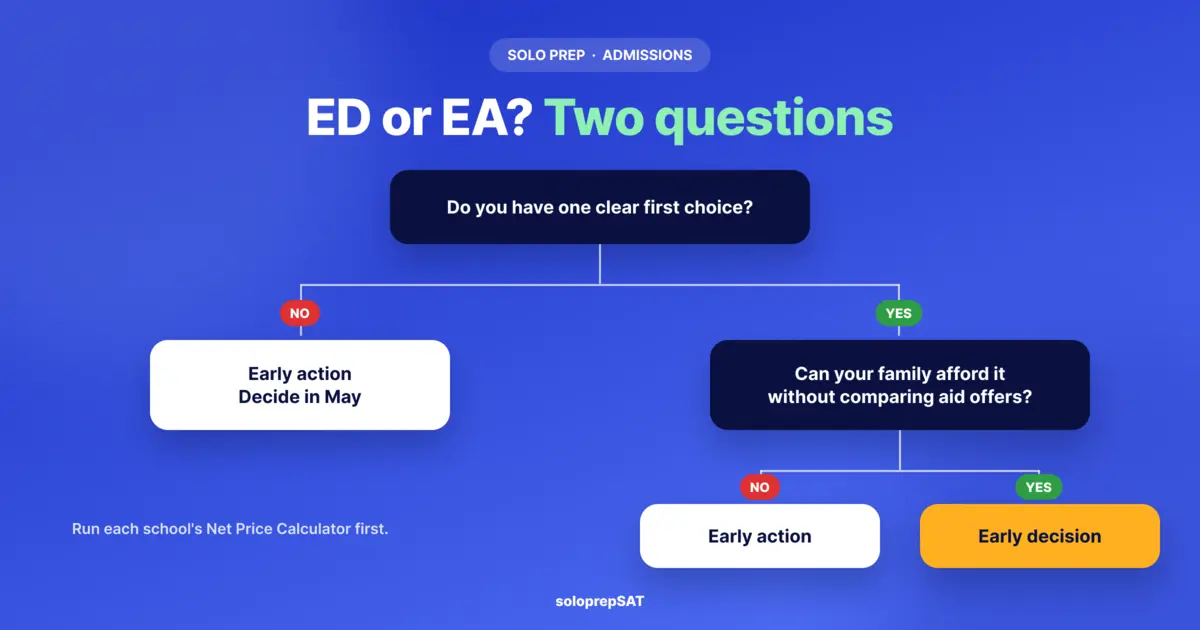
Early decision is a commitment. Early action is just an earlier deadline.
Early decision: a binding commitment
Applying ED tells a college it is your first choice and that you will attend if admitted. You, a parent and your school counselor each sign an Early Decision Agreement. If you are accepted, you withdraw every other application and send your enrollment deposit.
- One ED school at a time. You can apply to other schools early action or regular decision, as long as their rules allow it.
- The only standard way out is money. If the financial aid offer does not make attendance possible for your family, you can ask to be released. Run each school's Net Price Calculator before you apply.
- ED II is a second chance. Schools such as Vanderbilt, Emory, WashU, NYU and Boston College offer a second binding round with deadlines in early January, decided by mid-February.
Apply ED when
- You have one clear first choice you have researched and visited, in person or online.
- Your family can afford it without comparing aid packages, or the Net Price Calculator result works.
- Your grades and test scores through junior year already make you competitive there.
Early action: an earlier answer, no commitment
EA works like regular decision with an earlier deadline. You hear back sooner, you are free to apply anywhere else, and you have until May 1, National Candidates Reply Date, to decide.
- Apply EA to several schools at once, for example a mix of public universities with EA rounds.
- Compare financial aid across every school that admits you.
- Get an early safety. An acceptance in December takes pressure off the rest of senior year.
The admission advantage is usually smaller than ED. At MIT, which offers non-restrictive EA, the early round admitted 5.5% of applicants for the Class of 2030, against 4.6% overall.
Restrictive early action (REA) and single-choice early action (SCEA)
A few highly selective universities offer a restricted version of EA. It is non-binding like EA, but it limits where else you can apply early. REA and SCEA are two names for the same idea.
| Plan | Schools | Binding? | Can also apply early to |
|---|---|---|---|
| Restrictive Early Action | Harvard, Stanford, Notre Dame | No | Public universities' EA, and any school's rolling admission; not other private schools' ED or EA |
| Single-Choice Early Action | Yale, Princeton | No | Same as above |
Each school words its restriction differently. Some allow early applications to foreign universities or to programs with a scholarship deadline. Read the restriction on the admissions website before you submit.
Which plans can you combine?
| Combination | Allowed? | Notes |
|---|---|---|
| ED at one school + EA at public universities | Yes | The most common strategy |
| ED at one school + EA at private universities | Usually | Allowed unless one of the EA schools is restrictive |
| ED at two schools | No | You may hold only one binding application at a time |
| REA/SCEA + EA at public universities | Yes | Public EA is not restricted |
| REA/SCEA + ED or EA at a private university | No | This is exactly what the restriction forbids |
| EA at several schools | Yes | No limit for non-restrictive EA |
Three common strategies
- Clear first choice: ED at one school, EA at two or three public universities, regular decision at five to eight more.
- Aiming at Harvard, Yale, Princeton or Stanford: REA or SCEA at one, public EA as a safety, regular decision everywhere else.
- Still deciding: EA at several schools, then regular decision, and choose in spring with every offer in hand.
Early acceptance rates: how big is the advantage?
At most selective private colleges, the early round admits a much larger share of applicants than the overall rate. Here are Class of 2030 numbers published by the schools and their student newspapers.
| School | Early plan | Early rate | Overall rate | Early ÷ overall |
|---|---|---|---|---|
| Brown | ED | 16.5% | 5.35% | 3.1× |
| Duke | ED | 13.8% | 4.7% | 2.9× |
| MIT | EA | 5.5% | 4.6% | 1.2× |
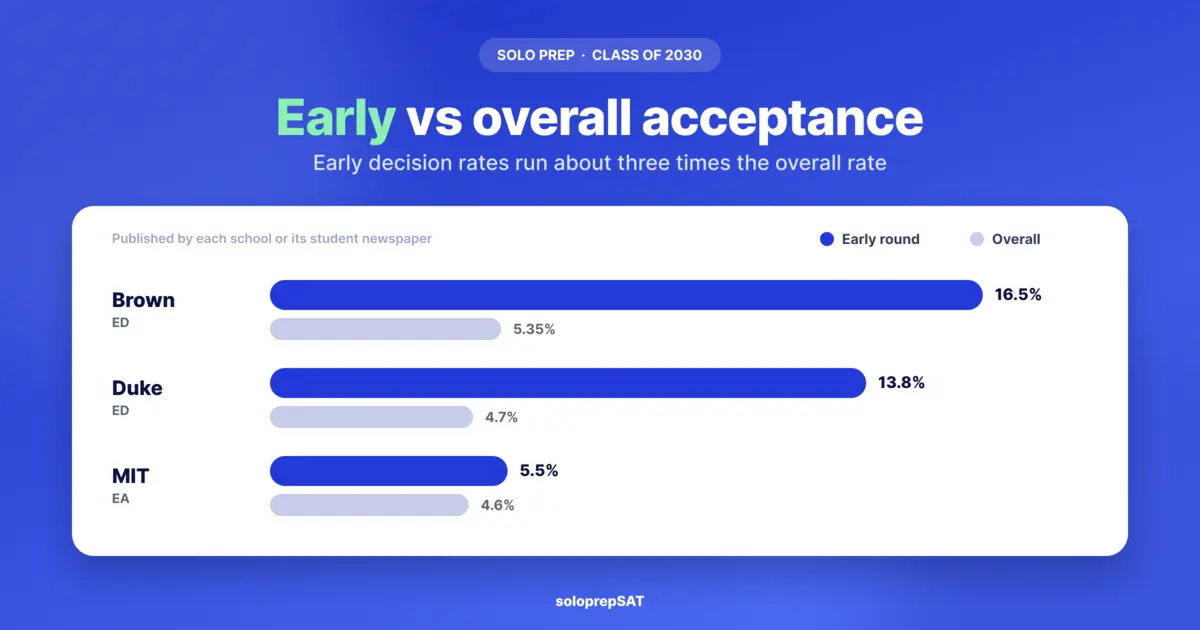
Part of the gap comes from who applies early. Early pools are full of recruited athletes, legacy applicants and students with finished applications, so the same student will not see a full three-times boost. Even so, colleges like ED because every admitted student enrolls, and that helps their yield. A strong applicant gets a real, if smaller, edge.
How to choose: five questions
- Do you have one clear first choice?
Yes: consider ED if the school offers it. No: apply EA to several schools and decide in spring.
- Does financial aid decide where you go?
If you need to compare offers, EA or regular decision protects you. ED only makes sense once the Net Price Calculator result works for your family.
- What does your target school offer?
Harvard, Yale, Princeton and Stanford offer REA or SCEA, not ED. Penn, Columbia, Brown, Duke, Cornell and Northwestern offer ED. MIT and Georgetown offer EA.
- Is your transcript finished?
Early applications are read on grades through junior year. If you need senior fall grades to show an upward trend, regular decision may present you better.
- Is your SAT score ready?
Most early deadlines can take scores from the October SAT, and some accept November. If your best score is still ahead of you, plan your test dates around the deadline with the 2026–27 SAT schedule.
FAQ
Can I back out of an early decision acceptance?
Only if the financial aid offer makes attending impossible for your family. Backing out for any other reason breaks the agreement you, your parent and your counselor signed, and other colleges can see it.
Can I apply early decision and early action at the same time?
Yes, in most cases: one ED school plus EA at other schools, as long as none of them uses restrictive early action. Read each school's early policy first.
Is restrictive early action binding?
No. REA and SCEA are non-binding, so you can still compare offers until May 1. The restriction is on where else you apply early, not on whether you enroll.
If I am deferred, what happens?
Your application moves to the regular decision pool and is read again with new grades. Send a short update letter with new achievements and senior fall grades if the school accepts them.
When are early decision results released?
Most ED and REA results come out in mid-December. EA results at large public universities can arrive from December to late January.
Sources