
 한국어
SAT format at a glance
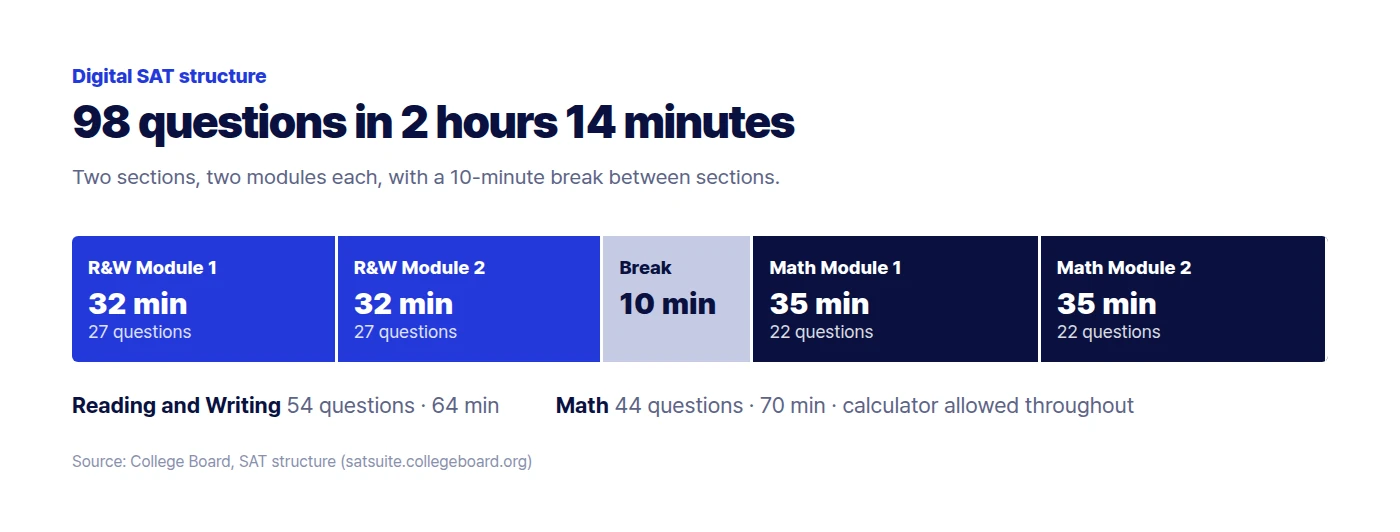
You take Reading and Writing (R&W) first, then a 10-minute break, then Math. Each section has two modules of equal length, and each module has its own timer.
| Section | Modules | Questions | Time | Score |
|---|---|---|---|---|
| Reading and Writing | 2 × 27 questions, 32 minutes each | 54 | 64 minutes | 200–800 |
| Break | 10 minutes | |||
| Math | 2 × 22 questions, 35 minutes each | 44 | 70 minutes | 200–800 |
| Total | 4 modules | 98 | 134 minutes (2 h 14 min) of testing | 400–1600 |
That works out to about 1 minute 11 seconds per R&W question and about 1 minute 35 seconds per Math question. Plan on a longer day overall: check-in, setup and the break add time, and College Board tells students their device needs to stay on for three to four hours.
How many questions are on the SAT
There are 98 questions: 54 in Reading and Writing and 44 in Math. Not all of them count. Each module includes two pretest questions that College Board is trying out for future tests. They look exactly like the other questions and are not scored.
| Section | Per module | Scored (operational) | Unscored (pretest) |
|---|---|---|---|
| Reading and Writing | 25 scored + 2 pretest | 50 | 4 |
| Math | 20 scored + 2 pretest | 40 | 4 |
| Total | 90 | 8 |
Since you cannot tell which questions are pretest items, treat every question as if it counts. Answer all of them, because a guess is better than a blank.
How adaptive routing between modules works
Module 1 in each section has a broad mix of easy, medium and hard questions. Your performance on it decides whether Module 2 is more difficult or less difficult. The same thing happens separately in R&W and in Math, so you can be routed to a harder Math module and an easier R&W module, or the reverse.
Your section score is based on your answers across both modules and on the difficulty of the questions you got right, not only on how many you got right. Reaching the harder Module 2 is what makes the top of the 200–800 range available. The Digital SAT scoring page explains this in more detail.
Module 1 is not a warm-up. Slow down enough to avoid careless errors on the easier questions there, and keep a steady pace so you reach every question before time runs out.
Reading and Writing section: the four content domains
Every R&W question comes with its own short passage of 25 to 150 words, sometimes paired with a table or graph. Passages cover literature, history and social studies, the humanities and science. Both modules include questions from all four domains.
| Domain | Share of scored questions | What it tests |
|---|---|---|
| Craft and Structure | About 28% | Words in Context; Text Structure and Purpose; Cross-Text Connections |
| Information and Ideas | About 26% | Central Ideas and Details; Command of Evidence (textual and quantitative); Inferences |
| Standard English Conventions | About 26% | Boundaries (punctuation and sentence structure); Form, Structure, and Sense (usage such as agreement and verb forms) |
| Expression of Ideas | About 20% | Rhetorical Synthesis; Transitions |
Standard English Conventions is the most rule-based domain, so it often moves fastest with focused study. Craft and Structure leans on vocabulary in context, which takes longer to build.
Math section: the four content domains
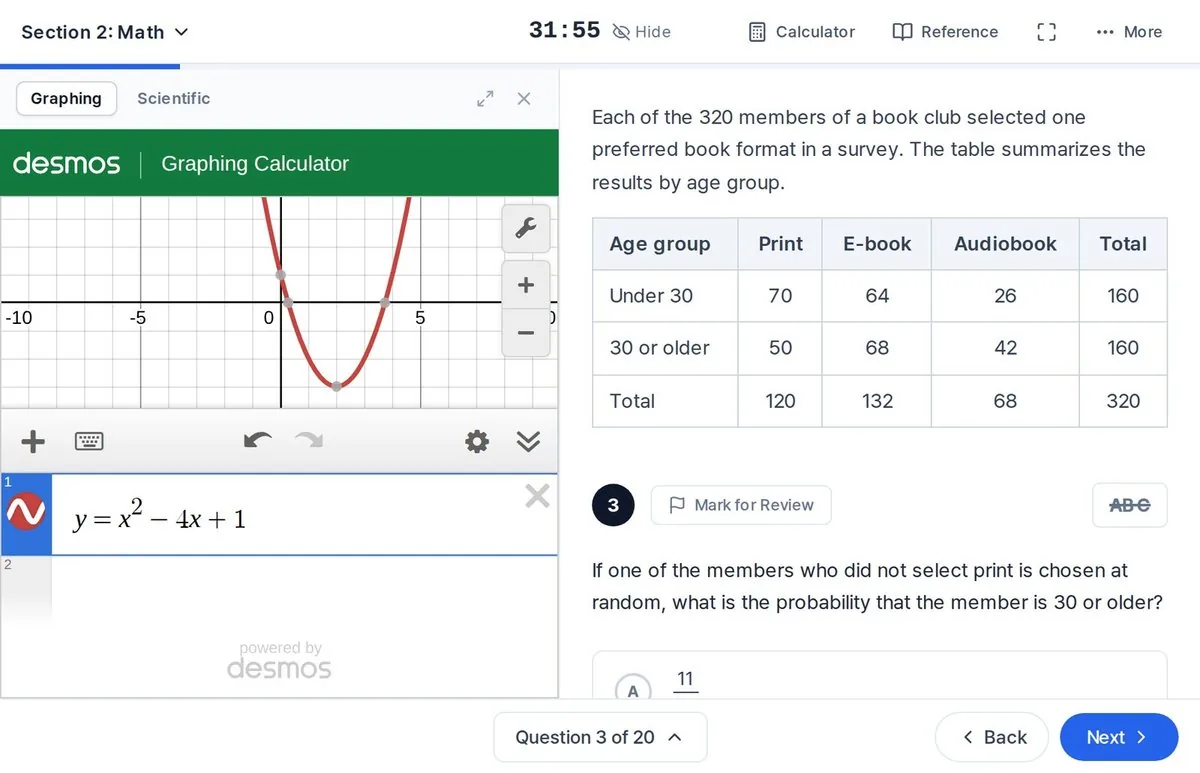
Math mixes multiple-choice questions with student-produced responses, where you type in your own answer. About 30% of Math questions are set in a real-world context, and the rest are straight math.
| Domain | Share of scored questions | What it covers |
|---|---|---|
| Algebra | About 35% | Linear equations in one and two variables, linear functions, systems of two linear equations, linear inequalities |
| Advanced Math | About 35% | Equivalent expressions; nonlinear equations and systems; nonlinear functions (quadratic, exponential, polynomial, rational, radical, absolute value) |
| Problem-Solving and Data Analysis | About 15% | Ratios, rates, proportions and units; percentages; one- and two-variable data; probability; sample statistics and margin of error; evaluating statistical claims |
| Geometry and Trigonometry | About 15% | Area and volume; lines, angles and triangles; right triangles and trigonometry; circles |
Algebra and Advanced Math together make up about 70% of the section, so they decide most Math scores. Geometry and Trigonometry has fewer questions, but they tend to reward students who know the core formulas well, and those formulas are on the built-in reference sheet.
Calculator, reference sheet and the break
- Calculator: allowed for the entire Math section. Bluebook has a built-in Desmos calculator with graphing and scientific modes, and you may also bring an approved handheld calculator. No calculator is allowed during Reading and Writing.
- Reference sheet: common formulas are available inside Bluebook throughout Math.
- Break: 10 minutes between the R&W section and the Math section.
- Timer: shown at the top of the screen; you can hide it, and it reappears when 5 minutes remain in a module.
Calculators with computer algebra systems (CAS), phone apps and anything with wireless connectivity are not allowed. See the SAT calculator guide for which models are permitted and how to use Desmos well.
Using the format to plan your prep
Because each domain has a predictable share of questions, you can study by weight. A sensible order for many students:
- Standard English Conventions, since the rules are finite and learnable.
- Algebra and Advanced Math, which together are about 70% of Math.
- Craft and Structure vocabulary, built steadily over weeks rather than crammed.
- Remaining domains, then timed full-length tests to practice pacing across four modules.
A full-length test is the best way to see how the format feels. Solo Prep's SAT practice tests follow the Bluebook layout with four modules, adaptive routing and a timer, and report accuracy by question type and by domain. For College Board's own full-length tests, see official SAT practice tests.
FAQ
How many questions are on the Digital SAT?
98 in total: 54 in Reading and Writing and 44 in Math. Eight of them, two in each module, are unscored pretest questions.
How long is the Digital SAT?
Testing time is 2 hours 14 minutes: 64 minutes of Reading and Writing, a 10-minute break, then 70 minutes of Math. Check-in and setup add time on test day.
How many sections does the SAT have?
Two: Reading and Writing, and Math. Each section has two modules, so there are four modules in all.
Is there still an SAT essay?
No. The Digital SAT has two sections, Reading and Writing and Math, and nothing else.
What are pretest questions on the SAT?
They are new questions College Board is trying out for future tests. There are two in every module, they look like any other question, and they do not affect your score.
Sources