
 한국어

What an SAT superscore is
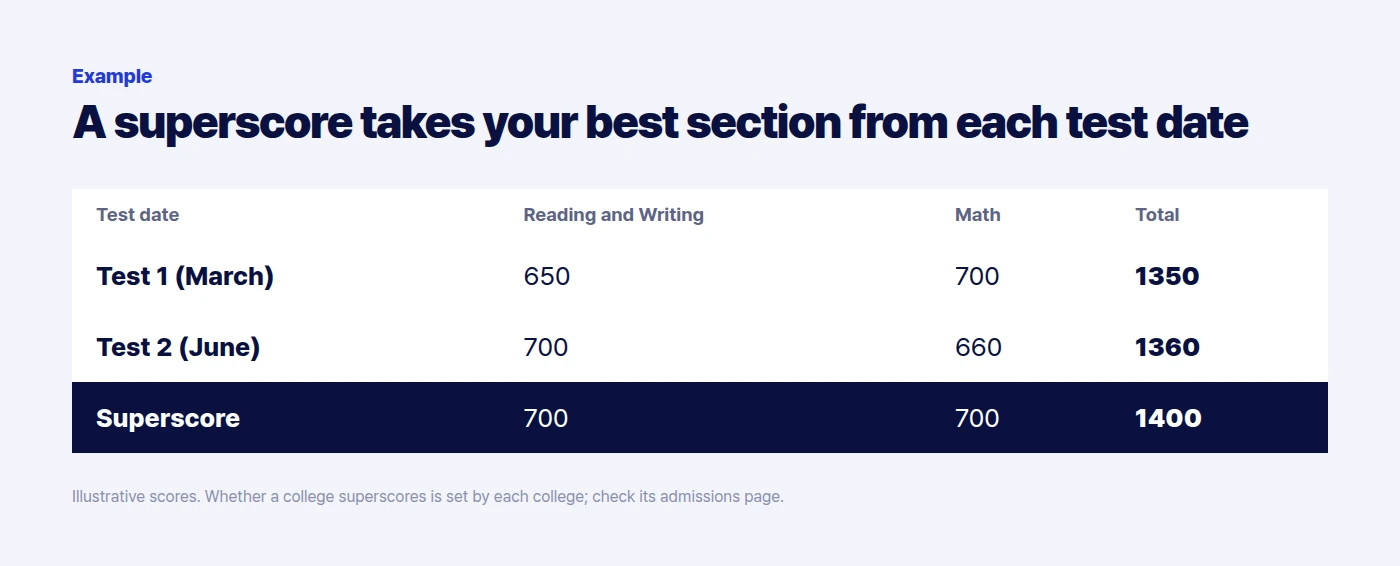
A superscore combines your highest Reading and Writing (R&W) score and your highest Math score from different test dates into one total. Colleges that superscore look at your best section results across every sitting they receive.
| R&W | Math | Total | |
|---|---|---|---|
| March test | 650 | 700 | 1350 |
| June test | 700 | 660 | 1360 |
| Superscore | 700 (June) | 700 (March) | 1400 |
You cannot build a superscore yourself when sending official scores. College Board sends whole test dates, never a single section from one date. The college does the combining. MIT, for example, says it primarily considers the highest score in each section when a student takes the same test more than once, and Yale lets applicants self-report superscored SAT results.
Because superscoring is common, many students plan two or three sittings and focus each round of prep on the weaker section. Policies differ by college, so check each school's admissions page.
How Score Choice works
Score Choice lets you decide which test dates to send to each college. If you have taken the SAT more than once, you can send only your best date, several dates, or all of them. Scores from the whole test on that date are sent together.
- You pick test dates per recipient when you order score sends in your College Board account.
- Some institutions ask to see all of your scores. While you choose, College Board shows the policy of each school you selected so you can send what it requires.
- Some colleges let you self-report scores in the application and only ask for official reports if you enroll. Stanford, for example, asks applicants to self-report their highest scores. MIT asks applicants to self-report every sitting.
Follow each college's own instructions first. Score Choice is a College Board feature; whether a college wants one sitting, your best sittings or every sitting is that college's policy.
Sending SAT scores: free sends, fees and timing
Colleges generally require official scores sent directly by College Board, not screenshots or transcripts. Each time you register for a weekend SAT, you get four free score sends. You can choose recipients when you register, change them up to test day, and still use or change them until nine days after the test. After that, every report has a fee.
| Service | Fee | Notes |
|---|---|---|
| First 4 score reports | Free | Order by 9 days after the test date (weekend SAT) |
| Additional score reports | $15 per report | Also applies to reports ordered after the 9-day window |
| Rush reporting | $31 | Plus the score report fee; only for scores already released |
| Archived scores | $35 | Plus the score report fee |
| Score verification | $55 | Order by phone through College Board customer service |
| Scores by phone | $15 per call | Credit card required |
Standard reports are sent electronically and typically go out within 5 to 10 business days of your order. Free sends you chose at registration go out a couple of weeks after test day. Rush reports go out within 1 to 4 business days, not counting weekends and holidays. Colleges may take extra time to process scores once they arrive.
If you took the SAT during the school day, the window is shorter: choose your free score sends during exam setup or within three days after testing, as your school instructs. Registration and other test fees are on the SAT fees page.
Should you use the four free score sends?
Free sends save $15 per college, but you commit before seeing your score. They make the most sense when your practice scores are already in your target range, when a college superscores and does not penalize lower sittings, or when your list is test-required and you will send every score anyway.
If a college wants only your best date and you are unsure how the test will go, waiting to see your score and paying for the report later keeps your options open. Weekend scores usually arrive about two weeks after the test, inside the window for most deadlines if you test early. Release dates are on the SAT scoring page.
Test-optional vs. test-required in 2026
Many US colleges went test-optional during the pandemic, and many still are. A growing group of selective universities has gone back to requiring the SAT or ACT. As of October 2026, the admissions offices of these schools state that scores are required for first-year applicants:
| University | Current policy (from its admissions site) |
|---|---|
| MIT | Requires the SAT or ACT; considers the highest score in each section |
| Harvard | Requires the SAT or ACT, with rare exceptions where testing is not accessible |
| Yale | Requires ACT or SAT scores; superscored results may be reported |
| Stanford | ACT or SAT required; applicants self-report their highest scores |
Policies change from year to year, and each college sets its own. Check the admissions website of every school on your list for the cycle you are applying in. At test-optional colleges, a score that sits at or above the school's middle 50% range usually helps; a score well below it may be better left out.
What is a good SAT score?
College Board describes the average SAT score as around 1050 and says 1350 or higher puts you in the top 10% of test takers. That is useful context, but the number that matters is how your score compares with students admitted to the colleges you want.
- Get a baseline
Take a timed, full-length practice test. Solo Prep's SAT practice test follows the Bluebook format and reports a score, a percentile and a domain breakdown.
- Find each college's range
Look up the middle 50% SAT range for admitted first-year students on the college's Common Data Set or on BigFuture.
- Set the target
Aim at or above the 75th percentile for your most selective realistic choices, then split the gap between R&W and Math based on your domain results.
- Plan your sittings
Pick two or three test dates that leave time for scores to arrive before deadlines. Dates and deadlines are on the SAT test dates page.
Students juggling the SAT with AP or IB coursework can find timing advice on SAT prep alongside AP. For a study plan built around your target, email support@satsoloprep.com about live one-on-one classes on Zoom.
FAQ
Do colleges superscore the SAT?
Many do, including MIT, which considers your highest score in each section. Policies vary, so check each college's admissions site.
Can I send only my Math score from one date and R&W from another?
No. College Board sends the whole test from each date you choose. A college that superscores combines your best sections itself.
How many free SAT score sends do I get?
Four per weekend registration, which you can use or change until nine days after the test. After that, each report costs $15 unless you have a fee waiver.
How long does it take to send SAT scores?
Standard reports typically go out within 5 to 10 business days of your order. Rush reports ($31 plus the report fee) go out within 1 to 4 business days, but only for scores already released.
Do I have to send all my SAT scores?
Not usually. Score Choice lets you pick test dates, but some colleges ask for every score, and you should follow their rules.
Is the SAT required again at top universities?
Several have reinstated it. As of October 2026, MIT, Harvard, Yale and Stanford all state that SAT or ACT scores are required.
Sources
- College Board: Sending SAT scores
- College Board: Sending scores from SAT Weekend
- College Board: SAT test fees
- College Board: What is a good score?
- College Board: Score release dates
- MIT Admissions: Tests and scores
- Harvard College: Application requirements
- Yale Admissions: Standardized testing
- Stanford Admission: Testing