
 한국어

What is different for international school students
The test itself is identical. College Board states that SAT weekend test dates and deadlines apply to all students, US and international, and late registration is available worldwide for an extra fee. The differences are in everything around the test.
- Curriculum. Your school may follow an American, British (IGCSE and A Level), IB or national program. The SAT tests reading, writing and math skills, not a specific curriculum, so the gaps you need to fill depend on what your school has and has not covered.
- School calendar. Exam weeks and long breaks fall at different times in different countries. Map them before you choose test dates.
- Test centers. International test centers can fill up and may be in another city. Register as soon as registration opens for the date you want.
- English background. Many international school students are strong in conversation but slower with dense academic prose. The Reading and Writing section rewards precise reading of short, formal texts.
For a full picture of the test format, read what the Digital SAT is.
SAT timeline for international school students, grade 9 to 12
Grade 9: build reading and algebra
Direct SAT prep is not the priority yet. Read nonfiction in English every day, including science and history articles, and keep a notebook of words you meet in context. Make sure linear equations, functions and basic statistics are solid. If your school offers the PSAT 8/9, take it as a low-stakes look at the format.
Grade 10: learn the test
Take one full-length timed practice test in Bluebook or on a similar platform and study the score report by domain. Learn each question type in Reading and Writing and the four Math domains: Algebra, Advanced Math, Problem-Solving and Data Analysis, and Geometry and Trigonometry. If your school offers the PSAT 10 or PSAT/NMSQT, take it for practice. The summer after grade 10 is the best window for a focused block of prep.
Grade 11: first official SAT and retest
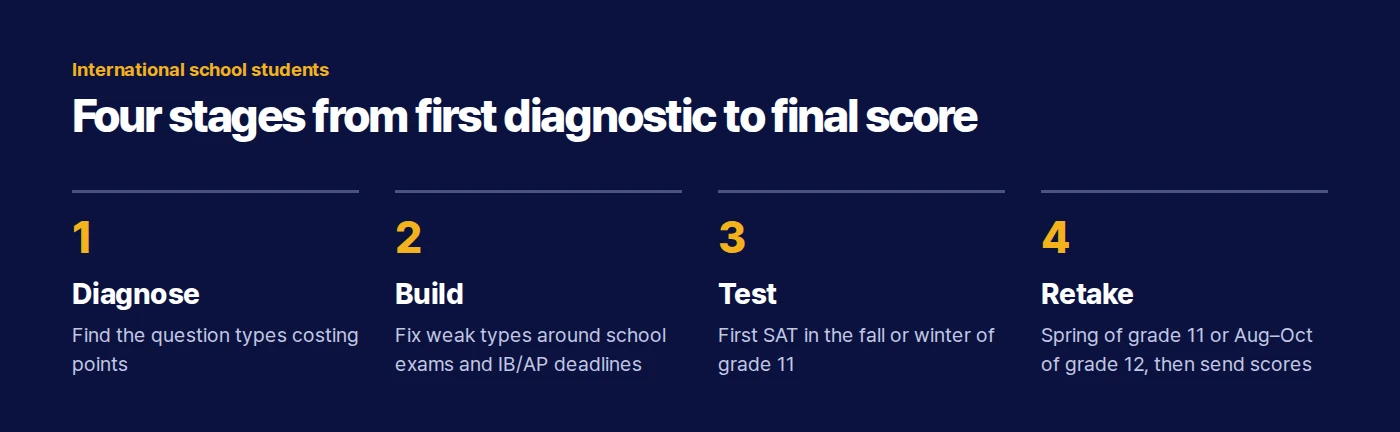
Sit your first official SAT in the fall or winter, once your practice scores are steady. Use the score report to target your weakest domains, then retest in the spring. College Board recommends taking the SAT at least twice, in the spring of junior year and the fall of senior year.
Grade 12: a final attempt, then applications
If you need one more attempt, take it in August, September or October so the score is ready for early deadlines. After that, put your time into essays, activities and your final college list.
| Grade | SAT focus | Tests to consider |
|---|---|---|
| 9 | English reading habit, vocabulary in context, algebra | PSAT 8/9 (if offered) |
| 10 | Question types, first practice test, summer prep block | PSAT 10 or PSAT/NMSQT (if offered) |
| 11 | First official SAT, targeted review, retest | SAT in fall or winter, SAT in spring |
| 12 | Final attempt if needed | SAT in August, September or October |
PSAT timing at international schools
The PSAT tests are given at school, and your school chooses whether to offer them. In the 2026-27 school year, College Board lists an October 1 to 30, 2026 window for the PSAT/NMSQT and PSAT 8/9, and a March 1 to April 30, 2027 window for the PSAT 10 and PSAT 8/9. Ask your counselor which ones your school runs.
The PSAT/NMSQT is given to students in grade 10 or 11. Students who take it in grade 11 may meet the requirements to enter the National Merit Scholarship Program, which is for US high school students. If you are a US citizen at a school abroad, check eligibility with National Merit directly before you count on it.
PSAT scores use a different scale from the SAT: 320 to 1520 for the PSAT/NMSQT and PSAT 10, and 240 to 1440 for the PSAT 8/9.
Fitting SAT prep around school exams
The SAT calendar is fixed. For 2026-27, the weekend test dates are August 22, September 12, October 3, November 7 and December 5, 2026, then March 6, May 1 and June 5, 2027. Your school calendar is the variable, so lay the two side by side.
- Avoid an SAT date that falls within two weeks of your school's semester exams or mock exams. Both will suffer.
- Use long breaks for intensive prep, then pick the first test date after the break while the material is fresh.
- If you take AP or IB exams in May, plan SAT attempts for the fall and winter, and use the June date only if May is light. Our AP plan and IB plan cover this in detail.
- Keep SAT practice going at a low weekly level during busy school terms so you do not have to rebuild skills later.
Registration deadlines are about two weeks before each test. See SAT test dates for the full table and SAT fees for registration and late fees.
When to start and how many attempts
Most students do well starting focused prep in the summer after grade 10. Start earlier if English is not your strongest language or if your first practice test is far below your target. Starting earlier does not mean studying harder for longer; it means a lighter weekly load spread over more months.
There is no limit on how many times you can take the SAT. Before each retest, change something specific: a domain you have drilled, a timing habit you have fixed. Retesting without new preparation rarely moves the score.
Colleges differ in how they treat scores from several test dates. Read how superscores and score sending work before you decide how many dates to book.
US application deadlines and your last SAT date
US colleges usually offer early decision or early action deadlines in October or November of grade 12, and regular decision deadlines later in the winter. Each college sets its own dates, so check every school on your list.
Most weekend SAT scores are released two to four weeks after test day. In 2026, for example, the October 3 scores come out on October 16 and the November 7 scores on November 20. That makes October the last safe date for most November 1 early deadlines, and December the last realistic date for many regular decision deadlines. Confirm with each college whether it accepts later scores.
Write down your earliest application deadline, subtract four weeks for scores, and that is the latest test date you can rely on. Book the attempt before that one as your main target.
Studying for the SAT from anywhere
Good SAT teachers can be hard to find outside major cities. Solo Prep teaches live one-on-one and small-group classes on Zoom, not recordings, scheduled for your time zone. Our practice platform runs Bluebook-style full-length tests with adaptive routing and shows accuracy by question type and domain.
You can start with the free 56-minute diagnostic. To plan your timeline with us, email support@satsoloprep.com with your grade, school curriculum and country.
FAQ
Do international students take a different SAT?
No. Students outside the US take the same Digital SAT in Bluebook, and College Board states that the weekend test dates and deadlines apply to both US and international students.
When should international school students take the SAT?
A common plan is a first attempt in the fall or winter of grade 11, a retest in the spring, and one final attempt in August, September or October of grade 12 if needed.
Can I take the PSAT at an international school?
Only if your school offers it, because the PSAT tests are given in school. Ask your counselor which PSAT tests your school runs and when.
What is the last SAT date for early decision?
For a November 1 deadline, the October test is usually the last safe date, since most weekend scores arrive two to four weeks after test day. Check each college's policy on late scores.
How many times can I take the SAT?
As many times as you want. College Board recommends taking it at least twice.
Sources