
 한국어

SAT score range: 400 to 1600
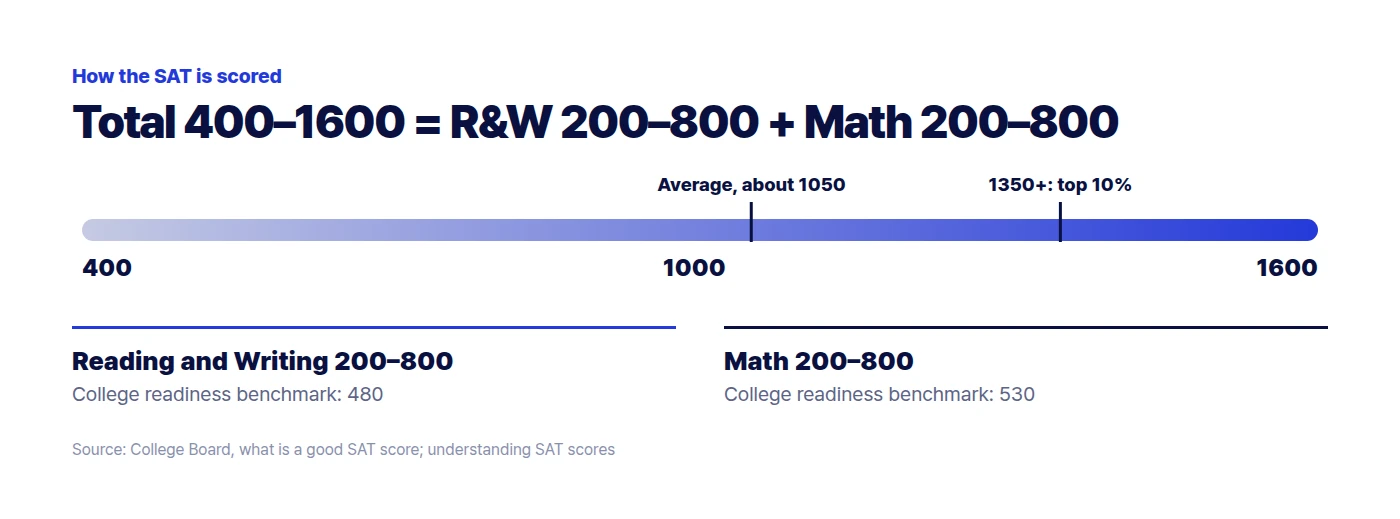
The SAT reports a total score from 400 to 1600. It is the sum of two section scores, each on a 200–800 scale: one for Reading and Writing (R&W) and one for Math.
| Score | Range | Based on |
|---|---|---|
| Total score | 400–1600 | Sum of the two section scores |
| Reading and Writing | 200–800 | 50 scored questions across two modules |
| Math | 200–800 | 40 scored questions across two modules |
Your score report also shows how you did in each content domain, so you can see where points were lost. The domains are listed on our Digital SAT format page.
How adaptive scoring works (IRT)
The Digital SAT is scored with Item Response Theory (IRT), the same family of methods used by NAEP, NWEA MAP and many state tests. Under IRT, your score depends on which questions you answered correctly and how hard those questions were, not only on how many you got right.
College Board says plainly that two students with the same number of correct answers in a section can receive different section scores, depending on the difficulty of the questions each one answered correctly. The scoring model also takes into account the chance that a pattern of answers reflects guessing.
Adaptive routing feeds into this. Everyone takes a mixed-difficulty Module 1; strong performance there leads to a harder Module 2. Your section score is based on all your answers across both modules. Harder questions answered correctly count for more, which is why reaching the harder Module 2 matters for the highest section scores. For how routing works, see what the Digital SAT is.
Online charts that convert "number correct" into a scaled score for the Digital SAT are estimates. Under IRT the same number of correct answers can lead to different scaled scores depending on which questions you got right, so treat any fixed raw-to-scaled chart as an approximation.
Wrong answers, guessing and unscored questions
- Answer every question. There is no deduction for a wrong answer, and College Board advises that guessing is better than leaving a question blank, especially after ruling out one or two choices.
- Pretest questions do not count. Each module has two unscored pretest questions that College Board is trying out for future tests. You cannot tell which ones they are, so give every question full effort.
- Both modules count. Module 1 is not a placement quiz that gets thrown away. Your answers there are part of your section score and also decide your Module 2.
SAT percentiles and what a score means
Your score report shows percentile ranks: the percentage of students who scored at or below you. College Board publishes two versions. The nationally representative percentile compares you with all US 11th and 12th graders, including those who do not usually take the SAT. The SAT User percentile compares you with actual SAT takers from the past three graduating classes. The User percentile is the more useful one for college admissions.
| Total score | Nationally representative | SAT User |
|---|---|---|
| 1550 | 99+ | 99 |
| 1500 | 99 | 97 |
| 1450 | 99 | 95 |
| 1400 | 97 | 93 |
| 1350 | 94 | 89 |
| 1300 | 91 | 85 |
| 1200 | 81 | 75 |
| 1100 | 67 | 62 |
| 1050 | 58 | 55 |
| 1000 | 48 | 47 |
For context, College Board describes the average SAT score as around 1050 and says a 1350 or higher is in the top 10% of test takers. The high school class of 2025 averaged 521 in R&W and 508 in Math, about 1029 in total. College Board's college readiness benchmarks are 480 for R&W and 530 for Math.
When SAT scores come out
Most weekend SAT scores are released two to four weeks after test day. You see them in your College Board student account at studentscores.collegeboard.org, where you can also open the full score report and skill details.
| Test date | Student score release |
|---|---|
| October 3, 2026 | October 16, 2026 |
| November 7, 2026 | November 20, 2026 |
| December 5, 2026 | December 18, 2026 |
| March 6, 2027 | March 19, 2027 |
| May 1, 2027 | May 14, 2027 |
| June 5, 2027 | June 21, 2027 |
In-school SAT scores follow a separate schedule set by the testing window. If you are counting back from an application deadline, add the time it takes colleges to receive scores; the sending SAT scores guide covers delivery times and fees. Full registration dates are on the SAT test dates page.
Setting a target score
A useful target comes from the colleges on your list, not from a general idea of what is "good." Look up each school's middle 50% SAT range for admitted first-year students on its Common Data Set or on College Board's BigFuture. Scoring at or above the 75th percentile of that range makes your score a clear strength; scoring near the 25th percentile means the rest of the application has to carry more weight.
- Take a full-length, timed practice test to get a starting score.
- List your colleges and note the middle 50% range for each.
- Set your target at or slightly above the 75th percentile of your most selective realistic choices.
- Split the gap between R&W and Math based on your domain breakdown, and plan how many official tests you will sit.
Solo Prep's SAT practice tests score instantly and show accuracy by question type, a domain breakdown and a percentile, which makes the gap concrete. For superscoring and which scores to send, read SAT superscore and Score Choice.
FAQ
What is the SAT score range?
The total score ranges from 400 to 1600. It is the sum of a Reading and Writing score and a Math score, each from 200 to 800.
Is the Digital SAT scored by number of correct answers?
No. It uses Item Response Theory, so the difficulty of the questions you answer correctly matters. Two students with the same number correct can get different scores.
Is there a penalty for wrong answers on the SAT?
No. A wrong answer and a blank earn the same, so you should answer every question. College Board recommends guessing over leaving a question blank.
How long does it take to get SAT scores?
Most weekend SAT scores are released two to four weeks after the test. For the 2026–27 weekend dates, College Board lists release dates about two weeks after each test.
What is a good SAT score?
College Board puts the average around 1050 and says 1350 or higher is in the top 10%. A good score for you is one at or above the middle 50% range of the colleges you are applying to.
Sources
- College Board: How scores are calculated
- College Board: What is a good score?
- College Board Research: SAT nationally representative and user percentiles
- College Board: Score release dates
- College Board: Getting your scores
- College Board Newsroom: Class of 2025 SAT results
- College Board: Reading and Writing specifications