
 한국어

The SAT in one paragraph
The SAT is a college admissions test run by College Board, a US nonprofit. It measures the reading, writing and math skills students build in high school and need in their first year of college. Scores go to colleges and scholarship programs, and many universities use them alongside grades, essays and activities.
The test is reported on a 400–1600 scale: one score of 200–800 for Reading and Writing (R&W) and one of 200–800 for Math. More than 2 million students in the US high school class of 2025 took the SAT at least once, and 97% of them took the digital version.
Two sections, four 32- or 35-minute modules, 98 questions, 2 hours 14 minutes of testing, taken on a laptop or tablet in the Bluebook app at a supervised test center or school. Not at home.
When and why the SAT went digital
The Digital SAT launched at international test centers in March 2023. The first fully digital SAT weekend in the United States was March 9, 2024, which completed the move of the whole SAT Suite (SAT, PSAT/NMSQT, PSAT 10 and PSAT 8/9) to digital testing.
College Board gave several reasons: a shorter test day, more time per question, simpler administration for schools, and stronger security. Every student sees a unique version of the test, which makes sharing answers practically impossible.
Some things did not change. The SAT still uses the 1600-point scale, still measures the same core skills, and is still given in a school or test center with a proctor present. College Board's concordance research found that digital and paper scores mean the same thing, so a 1050 on either version represents the same performance.
How adaptive (multistage) testing works
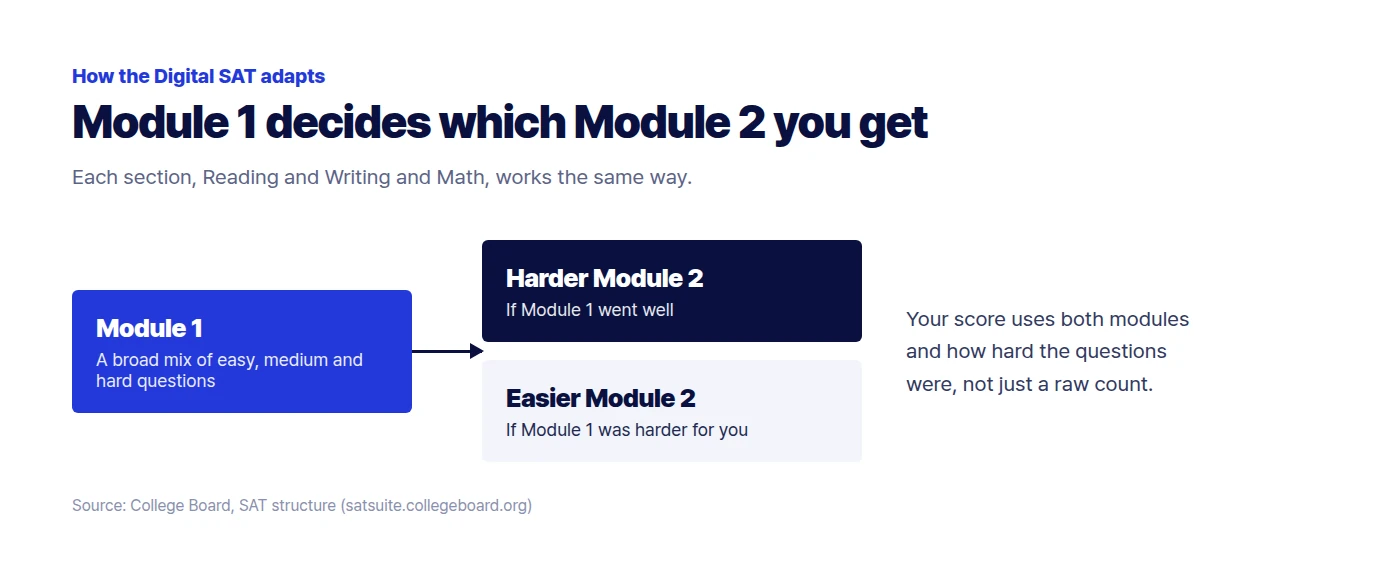
Each section is split into two equal-length modules. The first module has a broad mix of easy, medium and hard questions, and everyone sees the same mix. How you do on that first module decides whether your second module is more difficult or less difficult.
- Module 1
A mixed-difficulty set of questions. This module sets your path for the rest of the section.
- Routing
Bluebook uses your Module 1 performance to choose the next module. You do not see this decision while testing.
- Module 2
A harder or easier set, chosen by how you did on Module 1. Your section score is based on your answers in both modules.
This design is called multistage adaptive testing. It lets the SAT measure a student precisely with fewer questions than the paper test needed. The practical lesson is that careless errors on Module 1 cost more than they seem to, because they can lower the ceiling of the second module. The scoring model behind this is covered on our Digital SAT scoring page.
Bluebook, devices and test-day tools
Students take the SAT in Bluebook, College Board's testing app. It runs on Windows laptops, Mac laptops, iPads and school-managed Chromebooks. Phones and personal Chromebooks are not on that list. If you do not have an approved device for a weekend test, you can ask College Board to lend you one.
Bluebook has to be installed before test day, and you complete exam setup in the app before you arrive. Your device needs to stay on for three to four hours, so bring it fully charged along with a power cord or portable charger. If the internet drops or the battery dies mid-test, Bluebook lets you pick up where you left off without losing work or time.
| Tool | What it does |
|---|---|
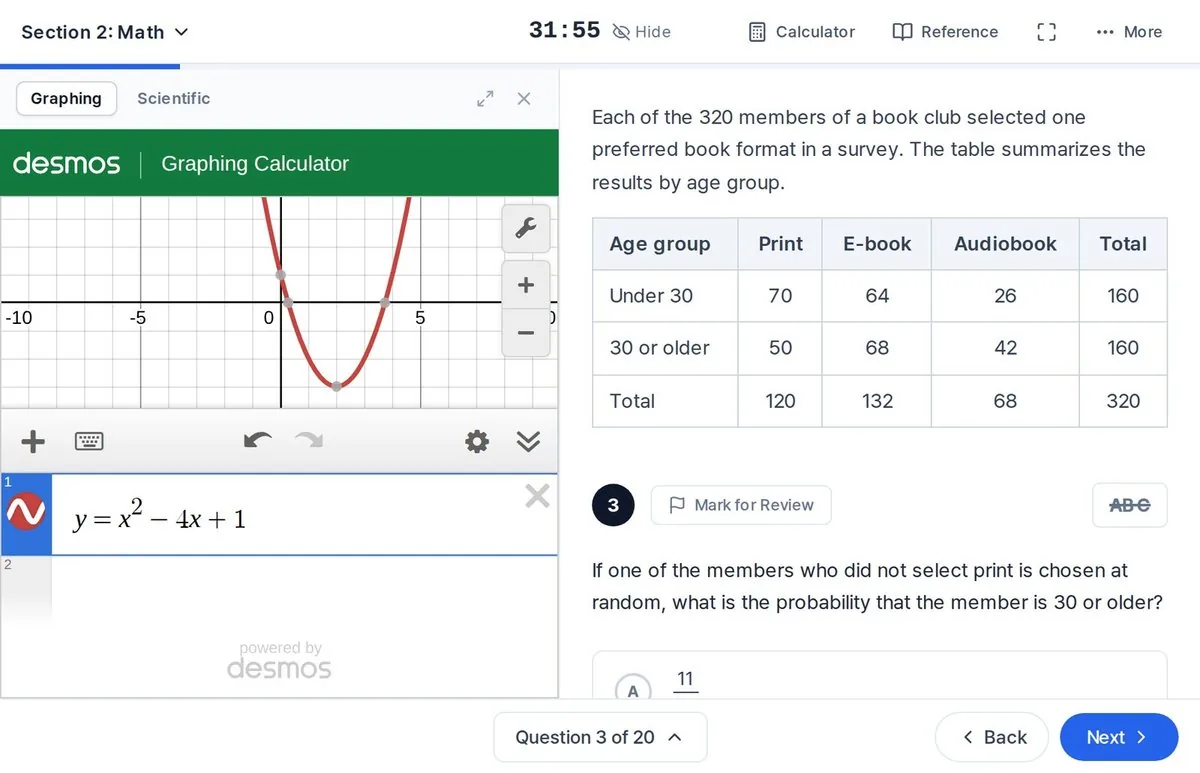
| Desmos calculator | Built-in graphing and scientific calculator, available throughout the Math section |
| Reference sheet | Common math formulas, available on every test with math questions |
| Timer | Shows time left in each module; you can hide it until the last 5 minutes |
| Highlights & Notes | Highlight text and leave notes on questions |
| Mark for Review | Flag a question to come back to before the module ends |
| Option Eliminator | Cross out answer choices you have ruled out |
| Line Reader and Zoom | Focus on one line of a passage; enlarge the screen |
Bluebook also contains free full-length official practice tests. Take at least one before test day so the interface feels routine. For packing lists and arrival rules, see the SAT test day guide.
Who takes the SAT
Most test takers are high school juniors and seniors applying to colleges in the United States. Many take it on a weekend at a test center; in the class of 2025, 68% of SAT takers tested during the school day through SAT School Day programs run by their states or districts.
Outside the US, the SAT is offered at international test centers, and it is widely used by students at international schools and in AP or IB programs who plan to apply to American universities. If that describes you, our pages on SAT prep for international school students and balancing the SAT with IB cover timing in more detail. Test dates and deadlines are on the SAT test dates page.
Digital SAT sections at a glance
| Reading and Writing | Math | |
|---|---|---|
| Questions | 54 (two modules of 27) | 44 (two modules of 22) |
| Time | 64 minutes (two 32-minute modules) | 70 minutes (two 35-minute modules) |
| Time per question | About 1 min 11 sec | About 1 min 35 sec |
| Score range | 200–800 | 200–800 |
| Calculator | Not allowed | Allowed on the whole section |
| Content domains | Information and Ideas; Craft and Structure; Expression of Ideas; Standard English Conventions | Algebra; Advanced Math; Problem-Solving and Data Analysis; Geometry and Trigonometry |
Reading and Writing passages are short, 25 to 150 words, and each one is paired with a single question. Most questions in both sections are multiple choice; some Math questions ask you to type in your own answer. Each module also includes two unscored pretest questions that you cannot tell apart from the rest. For the full breakdown by domain, read Digital SAT format and structure.
Digital SAT vs. the old paper SAT
| Paper SAT (through 2023) | Digital SAT | |
|---|---|---|
| How you test | Paper booklet and answer sheet | Bluebook app on a laptop or tablet |
| Testing time | 3 hours | 2 hours 14 minutes |
| Difficulty | Not adaptive | Adaptive: Module 2 depends on Module 1 |
| Reading passages | Long passages, each with a set of questions | 25–150 words, one question per passage |
| Calculator | Allowed on only part of the Math test | Allowed on the entire Math section, with built-in Desmos |
| Test form | Printed forms shared by many students | A unique version for every student |
| Score scale | 400–1600 | 400–1600 |
For students, the biggest practical shifts are pacing and reading style. You get more time per question, but you also switch topics with every question in R&W, which rewards quick, accurate reading of a short text over stamina with long passages. In Math, Desmos changes how many problems can be solved, and students who practice with it gain real time.
Where to start preparing
Take a timed, full-length practice test first, then study the questions you missed by type. Solo Prep's practice platform runs Bluebook-style full-length tests with all four modules, adaptive routing and a timer, then shows instant scores, accuracy by question type and a domain breakdown. Start with a full-length SAT practice test, or ask about live one-on-one classes on Zoom at support@satsoloprep.com.
FAQ
Is the Digital SAT easier than the paper SAT?
It is shorter and gives more time per question, but College Board designed it to measure the same skills on the same scale. Its concordance research found digital and paper scores comparable.
Can I take the Digital SAT at home?
No. The Digital SAT is taken in Bluebook at a school or test center with a proctor present.
Can I use a calculator on the Digital SAT?
Yes, on the entire Math section. Bluebook has a built-in Desmos calculator, and you may also bring an approved handheld calculator. Calculators are not allowed on Reading and Writing.
What devices can I use for the Digital SAT?
A Windows or Mac laptop, an iPad, or a school-managed Chromebook with Bluebook installed. If you do not have one, you can request to borrow a device from College Board for a weekend test.
Does a harder Module 2 mean a higher score?
Doing well enough on Module 1 to reach the harder Module 2 is what opens up the top of the score range. Your final section score depends on the difficulty of the questions you answered correctly across both modules.
Sources
- College Board: SAT structure
- College Board: How scores are calculated
- College Board Newsroom: Digital SAT launches across the country (March 12, 2024)
- College Board Newsroom: SAT participation, class of 2025
- College Board: Download Bluebook
- College Board: Bluebook testing tools
- College Board: SAT calculator policy
- College Board: Reading and Writing domains