 한국어
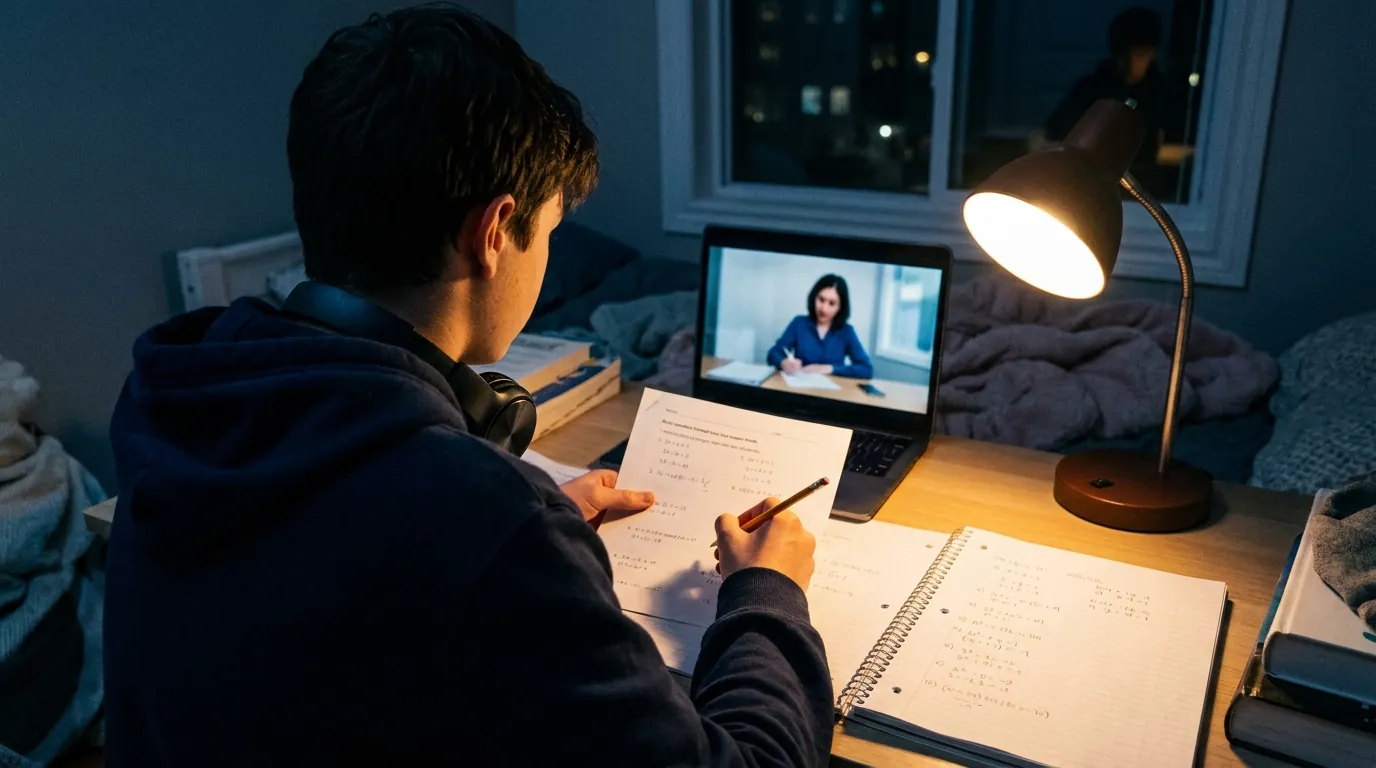
One-on-one tutoring or small-group classes
Every class is live on Zoom. There are no recorded lectures: the tutor and student work on the same screen, and questions get answered while the problem is still open.
| One-on-one tutoring | Small-group classes | |
|---|---|---|
| Who is in the class | One student, one tutor | Students who start near the same score |
| Curriculum | Built from the student's diagnostic, from the first session | Set for the group's score range |
| Schedule | Agreed in the consultation, in the student's time zone | Each group has fixed days and times |
| Homework | Homework and error log checked every session | Assigned by the type of question each student missed |
| Suits | Clear weak spots, a near test date, or a specific target | Students who work well alongside peers at a similar level |
One-on-one tutoring moves fastest because nothing in the lesson is aimed at anyone else. Small groups work because students at the same level tend to miss the same questions, so explanations are not wasted. Which groups are open at the moment is covered in the consultation, and we decide on the format together after looking at the diagnostic.

How a course runs
- Diagnostic
The student takes a diagnostic test. We look at accuracy by question type, not only the total, to see which types are costing points.
- Plan
We set a week-by-week plan from the target score, the test date and the diagnostic result, and agree on how many lessons a week are needed.
- Lessons
Live lessons on Zoom work through the weak question types, one at a time, with the steps for solving each type.
- Homework
After each lesson, homework is built from the types the student missed that day. Students do not all get the same assignment.
- Mock tests
Every four weeks the student takes a full-length mock test on our practice platform and compares it with the previous one.
- Adjust
The next month's plan is rewritten from the new result. Types that are fixed drop out and new weak spots move to the front.
Inside each four-week cycle: a mock test and weak-type report, then drills on the three weakest types, then timed practice, then the retest. The loop runs until the student reaches the target.
What a lesson looks like
- Before the lesson, the student receives the questions and materials for the day, so class time goes to solving and questions.
- During the lesson, tutor and student look at the same screen. The tutor marks up the question directly, and the student asks as soon as something is unclear.
- After the lesson, homework goes out based on the question types missed that day.
- Before the next lesson, the student gets feedback on that homework, and the next lesson starts from it.
We teach how to think through each question type rather than reading out the answer key.
Schedule and homework, on a page and by email
Every student has a private page with the next class, homework and schedule in one place, and we send reminders and schedule changes by email. Swipe through the examples below.
Swipe or scroll to see the student page and the emails we send.
Class reminder email

Class reminder
Jiwoo Park's class starts in 6 hours.
Join with the button below at class time.
Hong Kong time
Monday, Oct 20
5:00 – 6:00 PM
6:00 PM KST
Check your homework before class
module 1
15 16 17
module 2
9 11
You can see past lessons and homework on your My classes page.
Schedule change email
Schedule change
Jiwoo Park, your class time has changed.
We'll meet at the new time below.
Before
Wednesday, Oct 22
5:00 – 6:00 PM
New time · Hong Kong time
Thursday, Oct 23
5:00 – 6:00 PM
6:00 PM KST
You can see past lessons and homework on your My classes page.
Classes in your time zone
Students join from Asia, Europe and the United States, and lesson times are set by the student's local time. Common slots are weekday afternoons after school, weekday evenings and weekend mornings.
If you live in the US or Europe, the time difference to Asia shifts by one hour when daylight saving time starts or ends.
Practice between lessons
Between lessons, students use our self-study platform, which has an English interface. Full-length tests follow the Bluebook format (four modules, adaptive routing, a timer), and results come back instantly with accuracy by question type, a domain breakdown, a percentile and a 28-skill map.
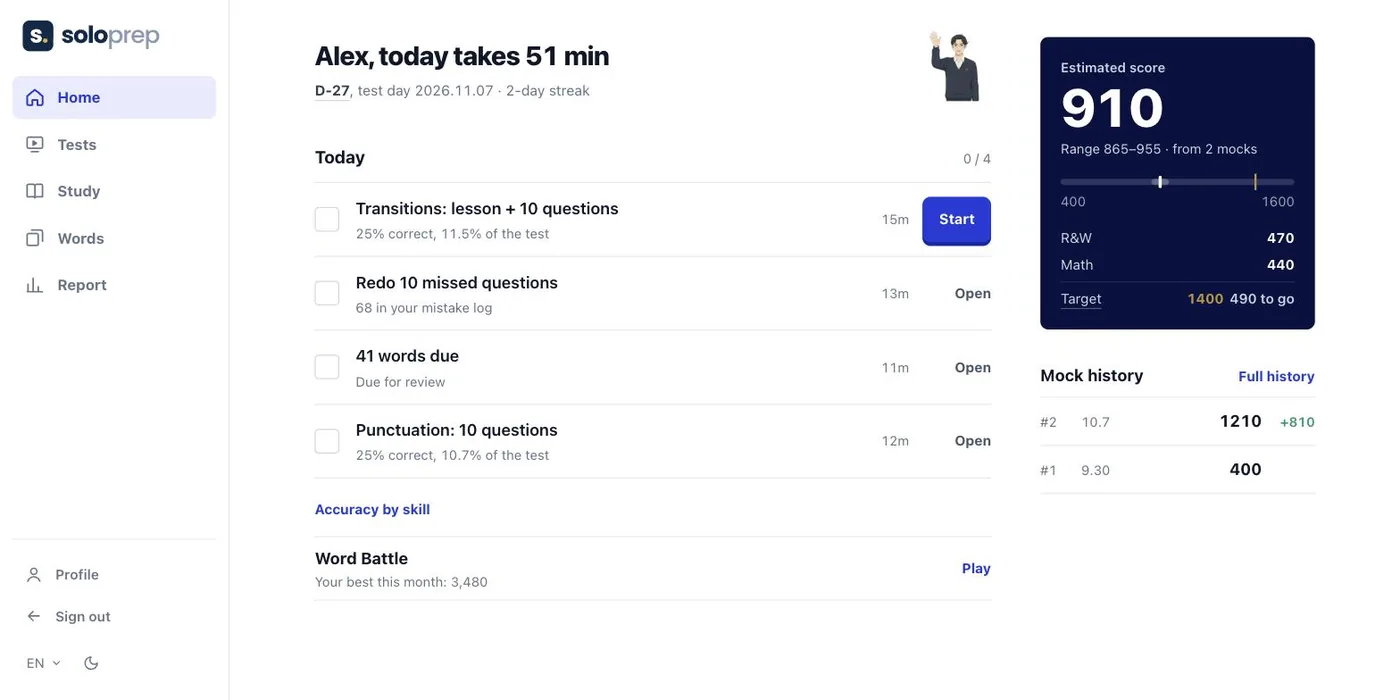
The question bank holds more than 2,500 questions written in-house, and homework drills come from it. For how the real test is built, see our Digital SAT guide.
How to start
Email support@satsoloprep.com with the student's grade, target score, planned test date and time zone. The consultation covers three things: what the diagnostic shows, a plan built from the target and test date, and which format and how many lessons a week fit.
The free diagnostic takes 56 minutes: 20 Reading and Writing and 20 Math questions, after signing in with Google. It is fully in English, with an explanation for every question. The first lesson can usually be scheduled within one to three days of the consultation.
Pricing depends on the format and the schedule, so we give it in the consultation rather than as a fixed package. If you are still deciding when to test, the SAT test dates guide helps set the timeline.
FAQ
Do the classes run live on Zoom?
The classes are live, not recorded. Tutor and student solve on the same screen and questions are answered on the spot, with materials before the lesson and homework and feedback after it.
Does each student get their own page?
Yes. Every student has a private page showing the next class, homework and schedule in one place. Reminders before each class, schedule changes and homework also go out by email.
I live in the US or Europe. Will the times work?
Yes. Lesson times are set in the student's local time zone, and one-on-one schedules are agreed in the consultation.
How much does SAT tutoring cost?
It depends on the format and how many lessons a week the student needs. We give pricing in the consultation once we know the goal and timeline.
Can I combine Solo Prep with another tutor or prep course?
You can, but two different materials and paces often add homework without adding progress. If you combine them, decide first which one leads.