
 한국어

What SAT grammar questions test
Standard English Conventions is one of the four content domains in the Digital SAT Reading & Writing section. These questions test punctuation, sentence structure and the forms of English grammar. Each R&W module has about 6 to 7 of them, so grammar is roughly 23 to 25% of the whole R&W section — about 13 to 14 questions per test.
Unlike inference or evidence questions, which turn on how you read a passage, grammar questions have an objectively correct answer set by a rule. That makes them the most learnable points on the test: know the rule and you get the question. It is why grammar is usually the fastest place to raise an R&W score.
Grammar is the one area of the SAT where memorizing a specific rule turns directly into a right answer. Reading questions need built-up skill; grammar needs a checklist. Master the rules and the points follow.
The five grammar types by frequency
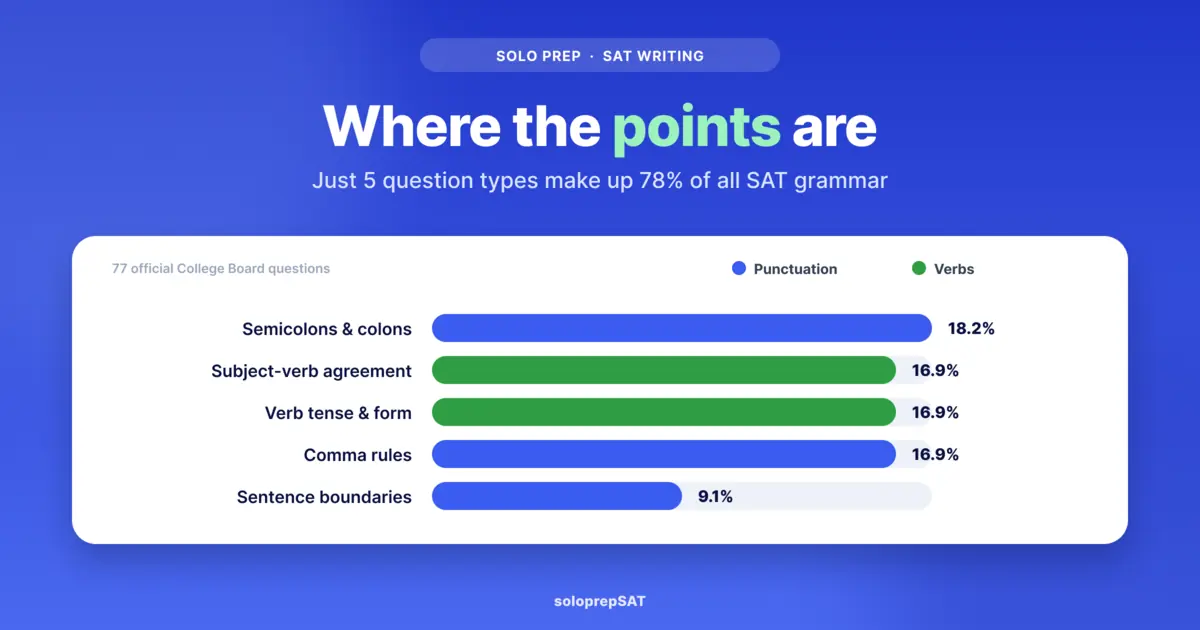
We went through all 77 grammar questions in 5 official College Board tests and sorted every one by type. The ranking below is what came out.
| Rank | Grammar type | Questions | Share |
|---|---|---|---|
| 1 | Semicolons & colons | 14 / 77 | 18.2% |
| 2 | Subject-verb agreement | 13 / 77 | 16.9% |
| 2 | Verb tense & form | 13 / 77 | 16.9% |
| 2 | Comma rules | 13 / 77 | 16.9% |
| 5 | Sentence boundaries | 7 / 77 | 9.1% |
These five types are 78% of all grammar questions. Grouped by theme, punctuation is 45.5% and verbs are 33.8% — so punctuation and verb rules alone cover almost 80% of the grammar you will see.
The rules and traps for each type
1. Semicolons and colons (18.2%)
The single most common type. You need to know when a semicolon, a colon or a comma is right.
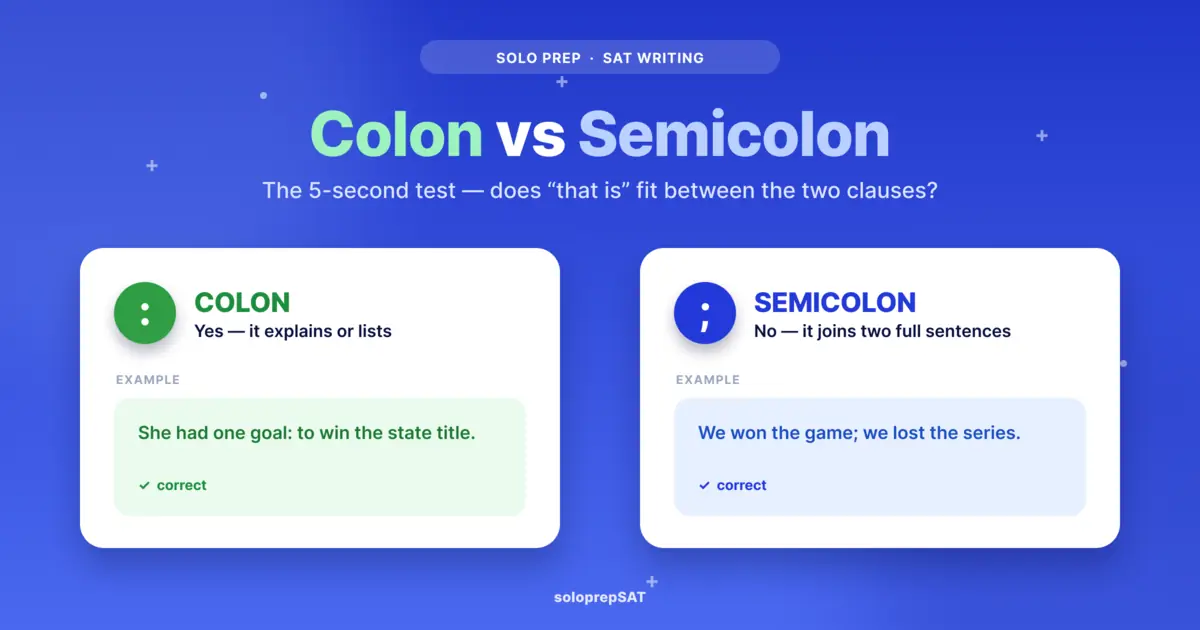
- Semicolon (;) joins two independent clauses with no conjunction. Both sides must be complete sentences.
- Colon (:) follows an independent clause and introduces an explanation, an example or a list. What comes after it expands on what came before.
- Semicolon + transition:
[clause]; however, [clause].The semicolon goes before the transition word, a comma after it.
The comma splice with "however." Choices like [clause], however, [clause] are always wrong — "however" needs a semicolon in front of it: [clause]; however, [clause].
2. Subject-verb agreement (16.9%)
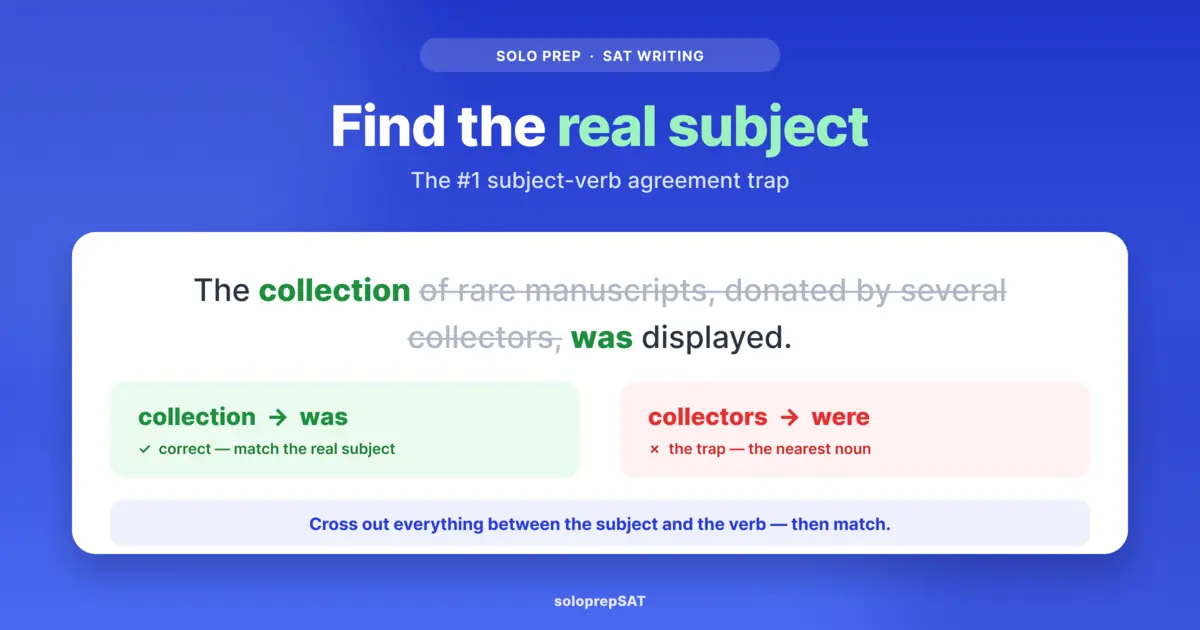
The subject and verb must match in number. Simple in principle, but the College Board hides the real subject.
- Ignore the phrase between subject and verb. "The list of items is long," not "are."
- each / every / neither / either are singular. "Each of the students has a book."
- A relative-clause verb agrees with its antecedent. "The students who are studying…" vs. "The student who is studying…"
A long modifier buries the subject: "The collection of rare manuscripts, donated by several private collectors over the past decade, was displayed…" The subject is "collection" (singular), not "collectors."
3. Verb tense and form (16.9%)
Pick the tense and form the passage points to.
- General facts and habits take simple present. "Water boils at 100°C."
- Finished past events take simple past. Look for time markers like "in 2019" or "last year."
- An -ing word or a to-infinitive alone is not the main verb. "The team working on the project" is a fragment — it needs a finite verb.
Overused past perfect. "Had + past participle" is only for showing one past event happened before another; most of the time simple past is correct.
4. Comma rules (16.9%)
Commas are tested in several places, but the core skill is telling essential information from non-essential.
- Essential (restrictive) element: no commas. "The novelist Jane Austen wrote Pride and Prejudice." (The name is needed to say which novelist.)
- Non-essential element: commas. "Jane Austen, a celebrated novelist, wrote Pride and Prejudice."
- A mid-sentence transition (however, though) takes a comma on each side.
- Non-restrictive "which" takes a comma before it. "The study, which was published in 2024, found…"
Putting commas around essential information. If removing the phrase changes what the sentence means, it is essential — leave the commas out.
5. Sentence boundaries (9.1%)
Spotting and fixing run-ons and fragments.
- Never a comma splice. Two independent clauses joined by only a comma is wrong. Fix it with a period, a semicolon, or a comma plus a conjunction.
- Indirect questions end in a period, not a question mark. "She asked whether the results were accurate."
- A fragment is missing a subject or a finite verb. A clause with only an -ing word and no helping verb is a fragment.
Missing a comma splice because the sentence is short. "The results were promising, the team continued the research" is a comma splice no matter how short it looks.
Two Solo Prep shortcuts
Rules get you the answer; speed gets you through the module. Two moves we teach early:
The 5-second colon-vs-semicolon test
Stuck between a colon and a semicolon? Try slipping "that is" or "in other words" between the two clauses.
- If "that is / in other words" fits → use a colon (the second part explains the first).
- If it does not fit → use a semicolon (the second part adds new but related information).
Check every rule, not just one
A common mistake is checking one rule and moving on. A single SAT question often tests two at once — say, subject-verb agreement and verb tense together. Run through every rule that applies before you choose. If a choice fixes one error but creates another, it is wrong.
A five-week study plan
Once you know which types carry the weight, you can spend your time where the questions are.
Weeks 1–2: punctuation (45.5% of grammar)
- Lock in semicolon vs. colon vs. comma.
- Practice spotting sentence boundaries.
- Drill comma-splice recognition — the most common error pattern.
- Run the "that is" test until colon-vs-semicolon is automatic.
Weeks 3–4: verbs (33.8% of grammar)
- Find the true subject in complex sentences.
- Drill subject-verb agreement with long phrases in the way.
- Master tense consistency and time-marker clues.
- Spot fragments that are missing a finite verb.
Week 5+: mixed practice and review
- Do mixed grammar sets under a timer.
- Log every miss by type and track the trend.
- Give your weakest one or two types extra time.
- Check every applicable rule on each question.
Most students split grammar time evenly across all types. That is inefficient. Punctuation (45.5%) and verbs (33.8%) are almost 80% of grammar — weight your study to the frequency and the score moves faster.
FAQ
How many grammar questions are on each SAT?
Each R&W module has about 6 to 7, so roughly 13 to 14 per test — about 23 to 25% of all R&W questions. The Digital SAT is adaptive, so Module 2 difficulty changes, but the share of grammar questions stays steady.
Is grammar the easiest way to raise an SAT score?
For most students, yes. Grammar is rule-based, so unlike reading it can be memorized and applied systematically. Students who put 2 to 4 focused weeks into grammar usually see the fastest R&W gains.
Should I study every grammar type or just the top five?
Start with the top five — they are 78% of grammar. Once those are solid, pick up the rest (pronouns, possessives, parallelism) for the other 22%. Aiming for 1400+ means covering them all; for a 1200 to 1300 goal, the top five alone move the needle.
How do I practice grammar questions well?
Drill by type, not at random: sort questions by the rule they test and master one type at a time. After you are at 90%+ on each type alone, switch to mixed, timed sets, and keep an error log sorted by type. The Solo Prep platform has type-sorted grammar drills.
Sources