
 한국어
How to use these example questions
Every question below matches a question type the College Board uses on the real test. Answer it before you open the explanation, and time yourself: on test day you have about 71 seconds per Reading and Writing question and about 95 seconds per Math question.
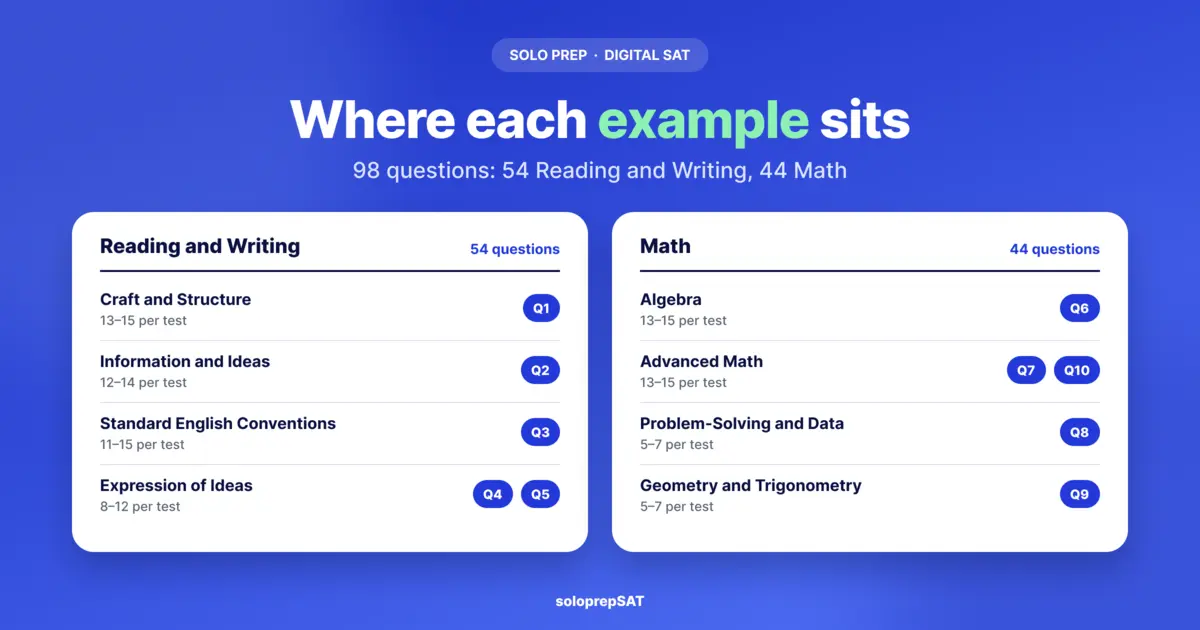
The test has 98 questions in two sections. Reading and Writing has 54 questions (two modules of 27, 64 minutes), and Math has 44 (two modules of 22, 70 minutes). Each section is adaptive: how you do in Module 1 decides whether Module 2 is easier or harder. For the full format, see the Digital SAT structure guide.
Wrong answers on the SAT are not random. Each type reuses the same few traps. When you check an explanation, read why the wrong choices are wrong, not only why the right one is right. That is where the points are.
Reading and Writing example questions
Reading and Writing questions each have one short passage (25 to 150 words) and one question. They appear in a fixed order by type, so the vocabulary questions always come first and Rhetorical Synthesis always comes last.
Question 1Words in ContextMedium
Which choice completes the text with the most logical and precise word or phrase?
- Agradual
- Bmodest
- Cstartling
- Dconsistent
Show answer and explanation
Answer: C
Okafor expected a slow recovery, then saw fast growth, and the growth was surprising enough that she checked her data. "Startling" fits both clues. "Gradual" and "modest" describe the slow recovery she expected, the opposite of what she found. "Consistent" does not explain why she would suspect an error.
Trap: choosing a word that matches the topic (slow reef recovery) instead of the logic of the sentence. The word "however" signals that the blank describes the surprise, not the expectation.
Question 2InferencesMedium
Which choice most logically completes the text?
- Aresidents of the settlement traveled to the highlands to learn how to make glaze.
- Bthe mineral used in the glaze was more common near the coast than researchers had assumed.
- Cglazed pottery was used only in religious ceremonies at the settlement.
- Dthe glazed pottery was likely made elsewhere and brought to the settlement.
Show answer and explanation
Answer: D
The glaze needs a highland mineral, and the settlement has no evidence of making glaze. Together these point to the pottery being made somewhere else and carried in. Choice A goes beyond the text: nothing says residents learned glaze-making. Choice B contradicts the text, which says no deposits of the mineral were found. Choice C introduces ceremonies, which the text never mentions.
Trap: an answer that sounds like a reasonable story but needs a fact the passage does not give.
Question 3BoundariesMedium
Which choice completes the text so that it conforms to the conventions of Standard English?
- AEarth,
- BEarth;
- CEarth, which
- DEarth and
Show answer and explanation
Answer: B
Both sides of the blank are complete sentences, so they must be separated by a semicolon or a period, or joined with a comma and a conjunction. A semicolon does the job. Choice A is a comma splice. Choice C makes the sentence ungrammatical ("which the satellite transmitted radio signals"). Choice D joins two independent clauses with "and" but no comma.
Rule: two independent clauses need a semicolon, a period, or a comma plus a FANBOYS conjunction (for, and, nor, but, or, yet, so).
Question 4TransitionsMedium
Which choice completes the text with the most logical transition?
- ATo address this,
- BFor example,
- CSimilarly,
- DNevertheless,
Show answer and explanation
Answer: A
The first sentence states a problem (blurry color fringes). The second describes Newton's solution. "To address this" connects a problem to a response. "For example" would need the second sentence to be an instance of the blurring. "Similarly" would need a second, parallel problem. "Nevertheless" signals that something happened despite the first sentence, which is not the relationship here.
Trap: picking a transition that sounds formal without naming the relationship. Before you look at the choices, say the relationship in your own words: problem, then solution.
Question 5Rhetorical SynthesisMedium
- The axolotl is a salamander native to lakes near Mexico City.
- It can regrow lost limbs, parts of its heart and even parts of its brain.
- The zebrafish is a small freshwater fish native to South Asia.
- It can regrow fin tissue and damaged heart muscle.
- Both species are studied by scientists researching tissue regeneration.
The student wants to emphasize a similarity between the two animals. Which choice most effectively uses relevant information from the notes to accomplish this goal?
- AThe axolotl is a salamander native to Mexico, while the zebrafish is a fish native to South Asia.
- BThe axolotl can regrow parts of its brain as well as lost limbs.
- CLike the axolotl, the zebrafish can regrow damaged heart tissue.
- DScientists study tissue regeneration in many species.
Show answer and explanation
Answer: C
Only choice C states something both animals share: they can regrow heart tissue. Choice A highlights a difference, and choice B describes only the axolotl. Choice D is about scientists in general and does not compare the two animals.
Trap: every choice is true to the notes. Rhetorical Synthesis questions are decided by the goal in the question, so read the goal first and test each choice against it.
In Solo Prep's analysis of the 528 Reading and Writing questions in official Practice Tests 4 to 11, every Rhetorical Synthesis question had wrong choices that were true but did not meet the goal, and 79% of Transitions questions had a wrong choice that pointed in the wrong logical direction. Know the trap for each type and the wrong answers get easier to drop.
Math example questions
Math covers four domains: Algebra, Advanced Math, Problem-Solving and Data Analysis, and Geometry and Trigonometry. You can use the built-in Desmos calculator on every question. About a quarter of the questions are student-produced responses, where you type the answer instead of choosing it.
Question 6Algebra · Linear equationsMedium
What is the sign-up fee, in dollars?
Student-produced response: type your answer.
Show answer and explanation
Answer: 70
Six extra months cost 370 − 190 = 180 dollars, so the monthly fee is 180 ÷ 6 = 30 dollars. Four months cost 4 × 30 = 120, so the sign-up fee is 190 − 120 = 70.
Trap: answering 30, the monthly fee. Underline what the question asks for before you start.
Question 7Advanced Math · QuadraticsHard
What is the value of c?
- A4
- B9
- C13
- D22
Show answer and explanation
Answer: C
The vertex of a parabola y = x² + bx + c is at x = −b ÷ 2 = 3. The minimum value is f(3) = 9 − 18 + c = c − 9. Setting c − 9 = 4 gives c = 13.
Trap: choice A treats the minimum value as c. Choice B is the value of x² at the vertex, a step on the way rather than the answer.
Question 8Problem-Solving · PercentagesMedium
The final price is what percent of the original price?
- A55%
- B60%
- C75%
- D80%
Show answer and explanation
Answer: B
Successive discounts multiply: 0.75 × 0.80 = 0.60, so the final price is 60% of the original.
Trap: adding the discounts (25% + 20% = 45% off) gives 55%, which is wrong because the second discount applies to the smaller sale price.
Question 9Geometry · CirclesHard
What is the radius of the circle?
- A5
- B7
- C10
- D25
Show answer and explanation
Answer: A
Complete the square: (x² − 8x + 16) + (y² + 6y + 9) = 16 + 9, so (x − 4)² + (y + 3)² = 25. The radius is √25 = 5.
Trap: choice D is r², and choice C is the diameter. In Desmos you can also type the equation and read the radius from the graph.
Question 10Advanced Math · SystemsHard
What is the value of c?
Student-produced response: type your answer.
Show answer and explanation
Answer: 9
Set the equations equal: x² − 4x + c = 2x, so x² − 6x + c = 0. One intersection point means one solution, so the discriminant is zero: 36 − 4c = 0, which gives c = 9.
Trap: answering 3, the x-coordinate of the intersection point, instead of c.
All SAT question types at a glance
The ten examples above cover the most common types. Here is the full list, with the number of questions you can expect per test.
| Section | Domain | Question types | Per test |
|---|---|---|---|
| Reading and Writing | Craft and Structure | Words in Context, Text Structure and Purpose, Cross-Text Connections | 13–15 |
| Reading and Writing | Information and Ideas | Central Ideas and Details, Command of Evidence (textual and quantitative), Inferences | 12–14 |
| Reading and Writing | Standard English Conventions | Boundaries, Form, Structure and Sense | 11–15 |
| Reading and Writing | Expression of Ideas | Transitions, Rhetorical Synthesis | 8–12 |
| Math | Algebra | Linear equations, inequalities, systems, linear functions | 13–15 |
| Math | Advanced Math | Quadratics, polynomials, exponentials, nonlinear functions | 13–15 |
| Math | Problem-Solving and Data Analysis | Ratios, rates, percentages, statistics, probability | 5–7 |
| Math | Geometry and Trigonometry | Area, volume, triangles, circles, right-triangle trigonometry | 5–7 |
Counts come from the College Board's published test specifications. Pretest questions are included in the 98, so the exact count by type varies slightly from test to test.
What to do after these questions
- Mark every miss by type
Write down the type and the trap you fell for, not just the question number. Two misses of the same type tell you more than ten random right answers.
- Take a full-length test
Example questions show the format; a timed test shows your pace. Use the official College Board tests in Bluebook, or take a Solo Prep mock test for a report by question type.
- Drill your weakest type first
The free 56-minute diagnostic gives you a projected score range and the types to fix first.
FAQ
Are these real SAT questions?
They are original questions written by Solo Prep SAT experts in the official College Board format and difficulty levels. For real retired tests, use the official practice tests in Bluebook or the PDF versions.
How many questions are on the Digital SAT?
98: 54 in Reading and Writing and 44 in Math, over 2 hours and 14 minutes. Each section has two modules, and Module 2 adapts to how you did in Module 1.
Which SAT questions are the hardest?
For most students: Boundaries questions with transition words, quantitative Command of Evidence, Cross-Text Connections, and Math questions with a constant to find, like question 10 above.
Can I use a calculator on every SAT Math question?
Yes. The Desmos graphing calculator is built into Bluebook and available for all 44 Math questions. You can also bring an approved handheld calculator.
Is there a penalty for wrong answers?
No. The Digital SAT has no guessing penalty, so answer every question, including student-produced responses.
Sources